


See below.
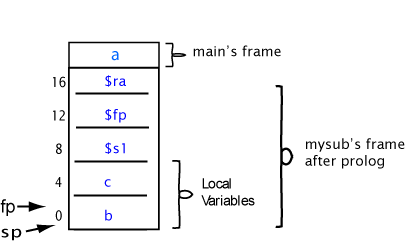
The subroutine uses two variables so there are eight bytes of space on the stack frame for them. The frame pointer points to the top of the stack.
After the prolog, the body of the subroutine uses the variables by using the frame pointer to access them. The stack pointer can be used for arithmetic evaluation and other purposes (but this program does not do that.)
Complete the body of the subroutine by filling in the blanks.
The program is not very efficient, as written.
There is no need to store and then load b.
A non-optimizing compiler might do just that, however.
#  int mysub( int arg )
#  {
#    int b,c;                     // b: 0($fp)
#                                 // c: 4($fp)
#    b = arg*2;
#    c = b + 7;
#
#    return c;
#  }
         .text
         .globl  mysub
mysub:
                                  # prolog
         sub     $sp,$sp,4        #   1. Push return address
         sw      $ra,($sp)
         sub     $sp,$sp,4        #   2. Push caller's frame pointer
         sw      $fp,($sp)

         sub     $sp,$sp,4        #   3. Push register $s1
         sw      $s1,($sp)

         sub     $fp,$sp,8        #   4. $fp = $sp - space_for_variables

         move    $sp,$fp          #   5. $sp = $fp

                                  # body of subroutine

         mul     $s1,$a0,2        # arg*2

         sw      $s1, ( )     # b = "   "

         lw      $t0, ( )     # get b

         add     $t0,$t0,             # b+7

         sw      $t0, ( )     # c = "  "

         . . . . .

                                   #  epilog
Fill in the blanks. Assume that b is at displacement 0
and that c is at displacement 4.